
The “Big Feeling” Rule: How to De-Escalate Any Argument
We’ve all been there. Your partner, friend, or coworker comes at you with a “big feeling.” Their voice is raised, their words are sharp, and suddenly, you feel that heat rising in your own chest. Your instinct is to fire back—to meet their volume with your volume and their logic with your defense.
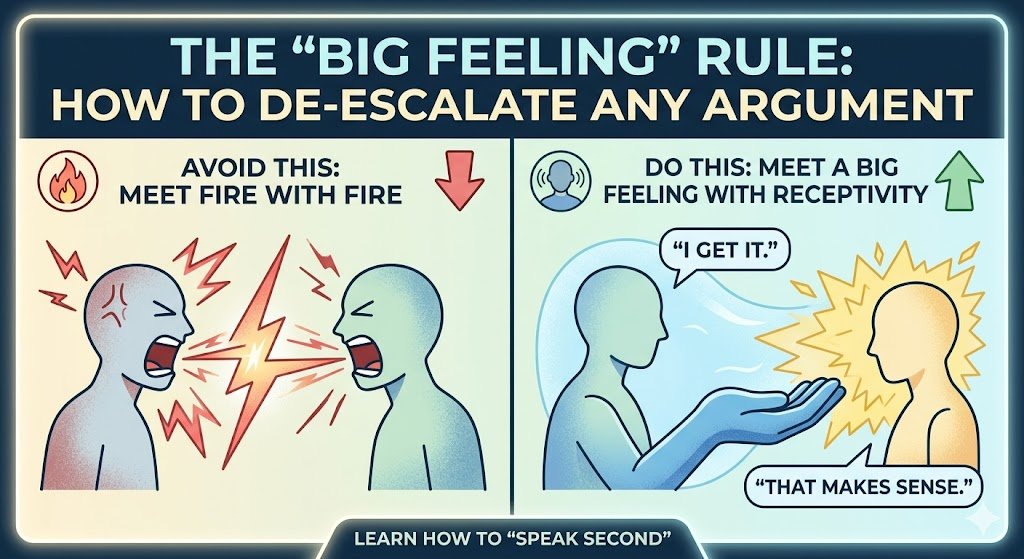
But if you want the relationship to be successful, there is one golden rule to live by: Never meet a big feeling with a big feeling.
Why “Matching Energy” Fails
When someone approaches you with intense emotion or “big words,” they aren’t just upset—they are triggered. In a triggered state, the logical brain takes a backseat to the emotional survival center. If you meet that fire with fire, you aren’t having a conversation; you’re just amplifying the heat. This leads to:
Ratcheting it up: The volume only goes higher.
The “3 D’s”: Dismissing, Debating, and Defending.
Total Gridlock: No one feels heard, and nothing gets solved.
The Secret Weapon: Receptivity
Instead of escalating, the most skillful move you can make is to meet that big feeling with receptivity. This isn’t about being “correct” or winning a debate; it’s about being effective.
Receptivity looks like creating a soft place for that big feeling to land. It sounds like:
“I get it.” (The three most powerful words in an argument).
“That makes sense.”
“I’m sorry you’re feeling this right now.”
“Is there more?” (A tough question to ask, but incredibly healing).
A Note on Apologizing: You aren’t necessarily apologizing because you did something wrong. You are expressing empathy for the fact that they are in pain. It validates their experience without requiring you to “lose” the argument.
The Power of “Going Second”
This doesn’t mean your feelings don’t matter. It’s simply about the order of operations. Wait for the storm to pass. Once they have come down “a few clicks” because they feel validated and understood, the space opens up for you.
Receive first: Calm the nervous system of the room.
Speak second: Share your perspective once the “big feeling” has subsided.
By choosing to be the receptive one, you stop the cycle of escalation and actually move toward a resolution. It takes practice, but “I get it” will take you a lot further than debating, minimizing, defending or dismissing. Try it.
We’ve all been there. Your partner, friend, or coworker comes at you with a “big feeling.” Their voice is raised, their words are sharp, and suddenly, you feel that heat rising in your own chest. Your instinct is to fire back—to meet their volume with your volume and their logic with your defense.
But if you want the relationship to be successful, there is one golden rule to live by: Never meet a big feeling with a big feeling.
Why “Matching Energy” Fails
When someone approaches you with intense emotion or “big words,” they aren’t just upset—they are triggered. In a triggered state, the logical brain takes a backseat to the emotional survival center. If you meet that fire with fire, you aren’t having a conversation; you’re just amplifying the heat. This leads to:
Ratcheting it up: The volume only goes higher.
The “3 D’s”: Dismissing, Debating, and Defending.
Total Gridlock: No one feels heard, and nothing gets solved.
The Secret Weapon: Receptivity
Instead of escalating, the most skillful move you can make is to meet that big feeling with receptivity. This isn’t about being “correct” or winning a debate; it’s about being effective.
Receptivity looks like creating a soft place for that big feeling to land. It sounds like:
“I get it.” (The three most powerful words in an argument).
“That makes sense.”
“I’m sorry you’re feeling this right now.”
“Is there more?” (A tough question to ask, but incredibly healing).
A Note on Apologizing: You aren’t necessarily apologizing because you did something wrong. You are expressing empathy for the fact that they are in pain. It validates their experience without requiring you to “lose” the argument.
The Power of “Going Second”
This doesn’t mean your feelings don’t matter. It’s simply about the order of operations. Wait for the storm to pass. Once they have come down “a few clicks” because they feel validated and understood, the space opens up for you.
Receive first: Calm the nervous system of the room.
Speak second: Share your perspective once the “big feeling” has subsided.
By choosing to be the receptive one, you stop the cycle of escalation and actually move toward a resolution. It takes practice, but “I get it” will take you a lot further than debating, minimizing, defending or dismissing. Try it.