
Have you ever felt like you can’t be entirely honest with your partner—or even with yourself?
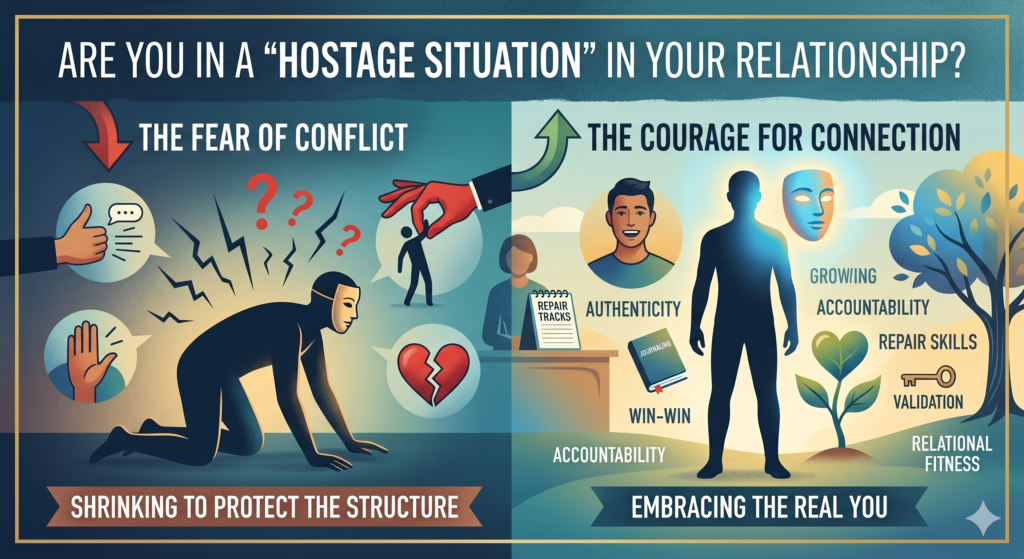
Many people find themselves in what I call a hostage situation in their marriage or partnership. They aren’t bound by ropes, but by a quiet, exhausting contract: they go along to get along, modify their behavior, and permanently walk on eggshells just to keep the peace.
If this sounds familiar, you are likely living in a compromised position, shrinking yourself down to keep the relationship afloat.
The Anatomy of the Compromise
In a relationship hostage situation, one partner is in constant “service mode,” acting out a role rather than showing up as their true self. Meanwhile, the other partner is getting a “deal”—a setup that works perfectly well for them.
The complicit partner might not even realize the depth of the issue because:
- The mechanism works: They might use control, forcefulness, aggression, or even financial dynamics to maintain the status quo.
- They get the benefits: They aren’t the ones at their wit’s end or feeling like they are living a lie.
- They accept the mask: Deep down, they may know they aren’t getting the real you, but because it functions smoothly, they don’t challenge it.
Choosing Protection Over Connection
If you are the one walking on eggshells, you have a crucial piece of internal work to do. You have to face the part of yourself that genuinely believes protection is better than connection.
We choose protection because the stakes feel incredibly high. You look around and see everything you stand to disrupt:
- A beautiful house you built together.
- Years or decades of shared history.
- The stability of your children.
To protect these things, an internal part of you forces you to stay small and silent. But while protecting the structure of your life works for a while, it ultimately thins out the actual connection until there is nothing left but a functional shell.
The Dilemma: “But They’re a Good Person”
One of the hardest predicaments to navigate is when there is no “bad guy.” How do you handle a thinning connection when your partner is a fundamentally good man or a good woman?
You tell your friends, your mother, and yourself: “They aren’t a bad person.” And you’re right. But it is entirely possible to have a good person and still have a compromised connection. Recognizing this isn’t an automatic directive to pack your bags and leave. It is simply a call to step into a sober reality and be brutally forthright about what you are actually experiencing.
How to Break the Silence
If you realize you’ve become a hostage to your own fear of conflict, it’s time for an awakening. This lifestyle is not sustainable for a healthy human spirit. Here is how you can begin to lean toward a solution:
- Start Reflecting Honestly: Begin journaling without censoring your thoughts. Read perspective-shifting books, such as Too Good to Leave, Too Bad to Stay by Mira Kirshenbaum. The diagnostic questions in resources like this can help you clarity whether you need to lean into repairing the relationship or lean away from it.
- Stop Acting: Practice making your boundaries and thoughts direct. The goal of a relationship is to find a connection where you can show up as mostly you.
- Prioritize Relational Fitness: Real growth means moving toward a connection that feels right on many levels, not just a setup that looks good on paper.
If you read the title of this post and instantly felt a pit in your stomach, you already know the truth. It’s time to stop staying small. You deserve to live a life where you can show up as your best, most authentic self.
If you’re ready to stop walking on eggshells and want to explore how to bring your real self back into your relationship, let’s talk. Visit BreakthroughCouples.com to learn more about my coaching tracks, or hit subscribe here for more strategies on building a transparent, lasting connection.