
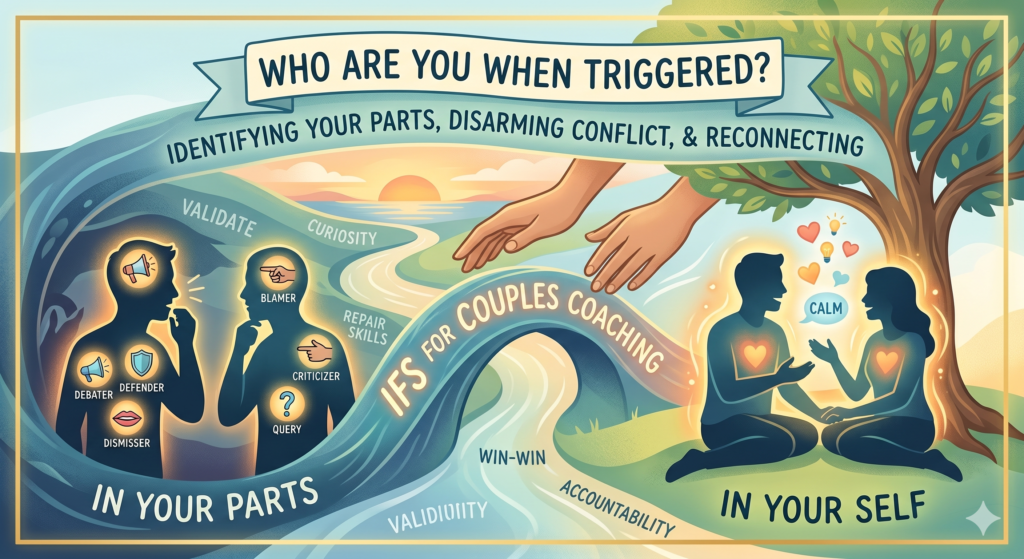
When couples walk into my office, they are usually locked in opposing narratives. Each partner feels an intense need to prove their point and make a case. The problem? Proving your point inherently invalidates your partner.
Most people don’t show up saying, “I have this sudden instinct to criticize and debate my partner, and I really want to understand where that comes from.” Instead, they arrive with a fixed, defensive view of who they are in the relationship, hoping I will act as a judge to determine who is right and who is wrong.
But real breakthroughs don’t happen by declaring a winner. They happen when we look at conflict through the lens of Internal Family Systems (IFS).
You’re Not You Anymore: Recognizing Your “Parts”
Everyone understands what it means to be triggered. We say things like, “I lost my cool” or “I ran out of patience.” But what IFS teaches us is a much larger idea: When you are triggered, you aren’t completely yourself. You have blended with a “part” of your personality.
When conflict heats up, your core Self takes a backseat, and your defensive parts take the wheel. These parts have distinct personas, such as:
- The Debater / Intellectualizer
- The Defender
- The Criticizer / Blamer
- The Dismissers / Scorekeepers
When two partners are both operating entirely from their defensive parts, you get an unproductive, reactionary cycle of punch and counter-punch. Your core relationship has temporarily vanished; it’s just two protective parts fighting for survival.
The Pull-Up of Relationships: Validate and Be Curious
Exiting this endless loop requires a simple concept that is hard to execute—much like doing a pull-up. Simple, but hard. It relies on a two-step process: Acknowledge and Announce.
Instead of letting a part drive the argument, you catch it, name it, and speak from it rather than as it.
What it sounds like: “I’m catching myself right now. I am in my short-fuse part.”
When you announce your part, it gives your partner a massive cue. They can look at you and realize, “Okay, it looks like my partner, but right now their short fuse is talking.” If your partner can stay anchored in their core Self, they can disarm the situation using two tools:
- Validation: Meeting that part with receptivity. “I get it. That makes sense. I’m sorry you’re in that space right now.”
- Curiosity: Asking what the part actually needs. “What did I say that triggered that short fuse? What does that part need from me right now to feel safe?”
Suddenly, the conversation shifts from an exhausting debate to a discovery. You discover that the “short fuse” is often just covering up deeper feelings of burden, inadequacy, or exhaustion. Once those underlying needs are met, the part can step down, and your core connection returns.
Relationship Fitness: Distance, Degree, and Duration
Couples don’t just lose their connection during arguments; they lose valuable time. I recently worked with a couple who hadn’t spoken for days after a fight. Others have lost an entire week to a single unresolved conflict.
As a relationship becomes healthier, you build a type of emotional fitness. I measure this fitness using the Three Ds:
- Distance: The amount of time between your conflicts grows longer.
- Degree: The intensity of the fights drops. You stop using harsh language or throwing low blows.
- Duration: The length of the conflict shortens dramatically.
Think of a highly conditioned athlete. When they sprint, their heart rate spikes, but the moment they stop running, their heart rate drops back down to a resting state almost immediately.
That rapid recovery is a hallmark of physical fitness. In a relationship, the speed at which you can return to a state of peace and connection after a trigger is the ultimate hallmark of relational fitness.
Skillfully usingIFS gives you a clear, efficient vocabulary to stop burning up your time with arguments, step out of your protective parts, and return to the connection you actually want.
Want to learn more about how to identify your parts and step out of unproductive conflict cycles? Visit BreakthroughCouples.com to explore coaching options, or subscribe to the channel for more strategy videos.